GATE CSE 1995 Previous-Year Questions (PYQs)
Section - A (100 Marks)
This question has 25 parts. Each part carries 1 mark. Choose the correct alternative for each part.
(25 x 1)
Question 1.
A single instruction to clear the lower four bits of the accumulator in 8085 assembly language?
(a) XRI OFH
(b) ANI FOH
(c) XRI FOH
(d) ANI OFH
Question 2.
Which or the following statements is true?
(a) ROM is a Read/Write memory
(b) PC points to the last instruction that was executed
(c) Stack works on the principle of LIFO
(d) All instructions affect the flags
Question 3.
In a vectored interrupt
(a) the branch address is assigned to a fixed location in memory
(b) the interrupt source supplies the branch information to the processor through an interrupt vector
(c) the branch address is obtained from a register in the processor
(d) none of the above
Question 4.
In the following Pascal program segment, what is the value of X after the execution of the program segment?
X:=-10; Y:=20;
If X > Y then if X < 0 then X:=abs(X) else X:=2*X;
(a) 10
(b) -20
(c) -10
(d) None
Question 5.
Merge sort uses
(a) Divide and conquer strategy
(b) Backtracking approach
(c) Heuristic search
(d) Greedy approach
Question 6.
The principle of locality justifies the use of
(a) interrupts
(b) DMA
(c) Polling
(d) Cache Memory
Question 7.
In a paged segmented scheme of memory management, the segment table itself must have a page table because
(a) The segment table is often too large to fit in one page
(b) Each segment is spread over a number of pages
(c) Segment tables point to page table and not to the physical locations of the segment
(d) The processor’s description base register points to a page table
Question 8.
Which of the following page replacement algorithms suffers from Belady’s anamoly?
(a) Optimal replacement
(b) LRU
(c) FIFO
(d) Both (a) and (c)
Question 9.
In some programming languages, an identifier is permitted to be a letter following by any number of letters or digits. If L and D denote the sets of letters and digits respectively, which of the following expressions defines an identifier?
(a) (L ∪ D)+
(b) L(L ∪ D)*
(c) (L.D)*
(d) L.(L.D)*
Question 10.
Consider a grammar with the following productions
S → aαb|bαc|aB
S → αS|b
S → αbb|ab
bα → bdb|b
The above grammar is:
(a) Context-free
(b) Regular
(c) Context-sensitive
(d) LR(k)
Question 11.
What are x and y in the following macro definition?
macro Add x,y
Load y
Mul x
Store y
end macro
(a) Variables
(b) Identifiers
(c) Actual parameters
(d) Formal parameters
Question 12.
What is the distance of the following code?
000000, 010101,101010, 000111, 011001, 111111
(a) 2
(b) 3
(c) 4
(d) 1
Question 13.
Which of the following strings can definitely be said to be tokens without looking at the next input character while compiling a Pascal program?
I. begin
II. program
III. <>
(a) I
(b) II
(c) III
(d) All of the above
Question 14.
A linker is given object modules for a set of programs that were compiled separately. What information need to be included in an object module?
(a) Object code
(b) Relocation bits
(c) Names and locations of all external symbols defined in the object module
(d) Absolute addresses of internal symbols
Question 15.
Which scheduling policy is most suitable for a time-shared operating system?
(a) Shortest Job First
(b) Round Robin
(c) First Come First Serve
(d) Elevator
Question 16.
For merging two sorted lists of sizes m and n into a sorted list of size m + n, we require comparisons of
(a) O(m)
(b) O(n)
(c) O(m + n)
(d) O(log m + log n)
Question 17.
A binary tree T has n leaf nodes. The number of nodes of degree 2 in T is:
(a) log2n
(b) n−1
(c) n
(d) 2n
Question 18.
The probability that a number selected at random between 100 and 999 (both inclusive) will not contain the digit 7 is:
(a) \(\frac{16}{25}\)
(b) \(\left(\frac9{10}\right)^3\)
(c) \(\frac{27}{75}\)
(d) \(\frac{18}{25}\)
Question 19.
Let R be a symmetric and transitive relation on a set A. Then
(a) R is reflexive and hence an equivalence relation
(b) R is reflexive and hence a partial order
(c) R is reflexive and hence not an equivalence relation
(d) None of the above
Question 20.
The number of elements in the power set P(S) of the set S={{Φ},1,{2,3}} is:
(a) 2
(b) 4
(c) 8
(d) None of the above
Question 21.
In the interval [0,π], the equation x = cos x has
(a) No solution
(b) Exactly one solution
(c) Exactly two solutions
(d) An infinite number of solutions
Question 22.
If at every point of a certain curve, the slope of the tangent equals \(\frac{-2x}y\) the curve is
(a) a straight line
(b) a parabola
(c) a circle
(d) an ellipse
Question 23.
The value of k for which 4x2 – 8xy + ky2 = 0 does not represent a pair of straight lines (both passing through the origin) is:
(a) 0
(b) 2
(c) 9
(d) 3
Question 24.
The rank of the following (n+1)×(n+1) matrix, where a is a real number is

(a) 1
(b) 2
(c) n
(d) Depends on the value of a
Question 25.
The minimum number of edges in a connected cyclic graph on n vertices is:
(a) n – 1
(b) n
(c) n + 1
(d) None of the above
This question has 25 parts. Each part carries 2 Marks. Choose the correct alternative for each part.
(25 x 2)
Question 26.
A sequence of two instructions that multiplies the contents of the DE register pair by 2 and stores the result in the HL register pair (in 8085 assembly language) is:
(a) XCHG and DAD B
(b) XTHL and DAD H
(c) PCHL and DAD D
(d) XCHG and DAD H
Question 27.
The capacity of a memory unit is defined by the number of words multiplied by the number of bits/word. How many separate address and data lines are needed for a memory of 4 K × 16?
(a) 10 address, 16 data lines
(b) 11 address, 8 data lines
(c) 12 address, 16 data lines
(d) 12 address, 12 data lines
Question 28.
Assume that X and Y are non-zero positive integers. What does the following Pascal program segment do?
while X <>Y do
if X > Y then
X:=X – Y
else
Y:=Y – X;
write(X);
(a) Computes the LCM of two numbers
(b) Divides the larger number by the smaller number
(c) Computes the GCD of two numbers
(d) None of the above
Question 29.
What is the value of X printed by the following program?
program COMPUTE (input, output);
var
X:integer;
procedure FIND (X:real);
begin
X:=sqrt(X);
end;
begin
X:=2
Find(X)
Writeln(X)
end.
(a) 2
(b) \(\sqrt2\)
(c) Run-time error
(d) None of the above
Question 30.
What values of A, B, C and D satisfy the following simultaneous Boolean equations? \(\overline A+AB=0,\;\;AB=AC,\;\;\\AB+A\overline C+CD=\overline{CD}\)
(a) A = 1, B = 0, C = 0, D = 1
(b) A = 1, B = 1, C = 0, D = 0
(c) A = 1, B = 0, C = 1, D = 1
(d) A = 1, B = 0, C = 0, D = 0
Question 31.
The sequence …………… is an optimal non-preemptive scheduling sequence for the following jobs which leaves the CPU idle for ……………………. unit(s) of time.
Job | Arrival | Burst time |
1 | 0.0 | 9 |
2 | 0.6 | 5 |
3 | 1.0 | 1 |
(a) {3,2,1},1
(b) {2,1,3},0
(c) {3,2,1},0
(d) {1,2,3},5
Question 32.
The address sequence generated by tracing a particular program executing in a pure demand paging system with 100 records per page with 1 free main memory frame is recorded as follows. What is the number of page faults?
0100, 0200, 0430, 0499, 0510, 0530, 0560, 0120, 0220, 0240, 0260, 0320, 0370
(a) 13
(b) 8
(c) 7
(d) 10
Question 33.
If the cube roots of unity are 1, ω and ω2, then the roots of the following equation are (x-1)3 + 8 = 0
(a) -1, 1 + 2ω, 1 + 2ω2
(b) 1, 1 – 2ω, 1 – 2ω2
(c) -1, 1 – 2ω, 1 – 2ω2
(d) -1, 1 + 2ω, -1 + 2ω2
Question 34.
A language with string manipulation facilities uses the following operations
head(s): first character of a string
tail(s): all but the first character of a string concat(s1,s2):s1 s2
for the string acbc what will be the output of concat(head(s), head(tail(tail(s))))
(a) ac
(b) bc
(c) ab
(d) cc
Question 35.
A shift reduce parser carries out the actions specified within braces immediately after reducing with the corresponding rule of grammar
S → xxW {print”1″}
S → y {print”2″}
W → Sz {print”3″}
What is the translation of xxxxyzz using the syntax directed translation scheme described by the above rules?
(a) 23131
(b) 11233
(c) 11231
(d) 33211
Question 36.
A variant record in Pascal is defined by
type varirec = record
number : integer;
case (var1,var2) of
var1: (x,y : integer);
var2: (p,q: real)
end
end
Suppose an array of 100 records was declared on a machine which uses 4 bytes for an integer and 8 bytes for a real. How much space would the compiler have to reserve for the array?
(a) 2800
(b) 2400
(c) 2000
(d) 1200
Question 37.
The number of 1’s in the binary representation of
(3*4096 + 15*256 + 5*16 + 3) are:
(a) 8
(b) 9
(c) 10
(d) 12
Question 38.
A unit vector perpendicular to both the vectors
a = 2i – 2j + k and b = 1 + j – 2k is:
(a) \(\frac1{\sqrt3}(i+j+k)\)
(b) \(\frac13(i+j-k)\)
(c) \(\frac13(i-j-k)\)
(d) \(\frac1{\sqrt3}(i+j-k)\)
Question 39.
A bag contains 10 white balls and 15 black balls. Two balls are drawn in succession. The probability that one of them is black and the other is white is:
(a) \(\frac23\)
(b) \(\frac45\)
(c) \(\frac12\)
(d) \(\frac21\)
Question 40.
The iteration formula to find the square root of a positive real number b using the Newton Raphson method is
(a) xk+1 = 3(xk + b)/2xk
(b) xk+1 = 3(xk+b)/2xk
(c) xk+1 = xk – 2xk/(\(x_k^2\) + b)
(d) None of the above
Question 41.
In a virtual memory system the address space specified by the address lines of the CUP must be __________ than the physical memory size and _______ than the secondary storage size.
(a) smaller, smaller
(b) smaller, larger
(c) larger, smaller
(d) larger, larger
Question 42.
Let A be the set of all non-singular matrices over real number and let* be the matrix multiplication operation. Then
(a) A is closed under* but < A, *> is not a semigroup
(b) < A, *> is a semigroup but not a monoid
(c) < A, *> is a monoid but not a group
(d) < A, *> is a group but not an abelian group
Question 43.
The solution of differential equation y’’ + 3y’ + 2y = 0 is of the form
(a) C1ex + C2e2x
(b) C1e-x + C2e3x
(c) C1e-x + C2e-2x
(d) C1e-2x + C22-x
Question 44.
If the proposition ¬p ⇒ ν is true, then the truth value of the proposition ¬pV(p⇒q), where ¬is negation, ‘V’ is inclusive or and ⇒ is implication, is
(a) true
(b) multiple valued
(c) false
(d) cannot be determined
Question 45.
Which of the following definitions below generates the same language as L,
where L = {xnyn such that n>=1}?
I. E → xEy|xy
II. xy|(x+xyy+)
III. x+y+
(a) I only
(b) I and II
(c) II and III
(d) II only
Question 46.
The postfix expression for the infix expression
A + B*(C + D)/F + D*E is:
(a) AB + CD + *F/D + E*
(b) ABCD + *F/DE*++
(c) A *B + CD/F *DE++
(d) A + *BCD/F* DE++
Question 47.
Which of the following statements is true?
I. As the number of entries in a hash table increases, the number of collisions increases.
II. Recursive programs are efficient
III. The worst case complexity for Quicksort is O(n2)
IV. Binary search using a linear linked list is efficient.
(a) I and II
(b) II and III
(c) I and IV
(d) I and III
Question 48.
A finite state machine with the following state table has a single input x and a single out z.
Present state | Next state, z |
|
| x=1 | x=0 |
A | D, 0 | B, 0 |
B | B, 1 | C, 1 |
C | B, 0 | D, 1 |
D | B, 1 | C, 0 |
If the initial state is unknown, then the shortest input sequence to reach the final state C is:
(a) 01
(b) 10
(c) 101
(d) 110
Question 49.
Let ∑ = {0,1}, L = ∑* and R = {0n1n such that n > 0} then the languages L∪R and R are respectively
(a) regular, regular
(b) not regular, regular
(c) regular, not regular
(d) not regular, no regular
Question 50.
A computer system has a 4K word cache organized in block-set-associative manner with 4 blocks per set, 64 words per block. The number of bits in the SET and WORD fields of the main memory address format is:
(a) 15, 40
(b) 6, 4
(c) 7, 2
(d) 4, 6
Question 51.
Consider the following high level program segment. Give the contents of the memory locations for variables W, X, Y and Z after the execution of the program segment. The values of the variables A and B are 5 CH and 92H, respectively. Also indicate error conditions if any.
var
A, B, W, X, Y : unsigned byte;
Z : unsigned integer(each integer is represented by two bytes)
begin
X :=A+B
Y :=abs(bA-b);
W :=A-B
Z :=A*B
End;
Question 52.
(a) Consider the following Pascal function where A and B are non-zero positive integers. What is the value of GET(3,2)?
function GET(A,B:integer);integer;
begin
if B = 0 then
GET:=1
else if A < B then
GET:=0
else
GET:=GET(A-1,B)+GET(A-1,B-1)
end ;
(b) The Pascal procedure given for computing the transpose of an N × N (N>1) matrix A of integers has an error. Find the error and correct it. Assume that the following declaration are made in the main program const
MAXSIZE=20;
type
INTARR=array [1.,MAXSIZE,1..MAXSIZE] of integer;
Procedure TRANSPOSE (var A: INTARR; N : integer);
var
I, J, TMP, integer;
begin
for I:=1 to NO – 1 do
for J:=1 to N do
begin
TMP: = A[I,J];
A[I,J]:=A[J,I];
A(J,I}:=TMP
end
end;
Question 53.
A computer installation has 1000k of main memory. The jobs arrive and finish in the following sequences.
Job 1 requiring 200k arrives
Job 2 requiring 350k arrives
Job 3 requiring 300k arrives
Job 1 finishes
Job 4 requiring 120k arrives
Job 5 requiring 150k arrives
Job 6 requiring 80k arrives
(a) Draw the memory allocation table using Best Fit and First fit algorithms.
(b) Which algorithm performs better for this sequence?
Question 54.
What is the number of binary trees with 3 nodes which when traversed in post order give the sequence A, B, C? Draw all these binary trees.
Question 55.
(a) Determine the number of divisors of 600.
(b) Compute without using power series expansion \(\lim_{x\rightarrow0}\frac{\sin\;x}x\)
Section - B (50 Marks)
Answer any TEN questions.
Question 56.
Construct the LL(1) table for the following grammar.
1. Expr → _Expr
2. Expr → (Expr)
3. Expr → Var Expr Tail
4. ExprTail → _Expr
5. ExprTail → λ
6. Var → Id Var Tail
7. VarTail → (Expr)
8. VarTail → λ
9. Goal → Expr$
Question 57.
(a) Translate the arithmetic expression a*−(b + c) into syntax tree.
(b) A grammar is said to have cycles if it is the case that
A ⇒+A
Show that no grammar that has cycles can be LL(1).
Question 58.
(a) Using the scope rules of Pascal determine the declaration that apply to each occurrence of the names A and B in the following program segment.
procedure T(U, V, X, Y: integer);
var
A: record
A, B : integer
end;
B: record
B, A : integer
end;
begin
with A do
begin
A:=4;
B:=V
end;
with B do
begin
A:=X;
B:=Y
end
end;
(b) Find the lexical errors in the following Pascal statement:
if A > 1, then B = 2.5A else read (C);
Question 59.
Let L be a language over ∑ i.e., L ≤ ∑*. Suppose L satisfies the two conditions given below
(i) L is in NP and
(ii) For every n, there is exactly one string of length n that belongs to L. Let Lc be the complement of L over ∑*. Show that Lc is also in NP.
Question 60.
Consider the following sequence of numbers
92, 37, 52, 12, 11, 25
Use bubble sort to arrange the sequence in ascending order. Give the sequence at the end of each of the first five passes.
Question 61.
Obtain the principal (canonical) conjunctive normal form of the propositional formula
(p ∧ q)V(¬q ∧ r)
Where ‘∧’ is logical and, ‘v’ is inclusive or and ¬is negation.
Question 62.
If the overhead for formatting a disk is 96 bytes for 4000 byte sector,
(a) Compute the unformatted capacity of the disk for the following parameters:
Number of surfaces: 8
Outer diameter of the disk: 12 cm
Inner diameter of the disk: 4 cm
Inter track space: 0.1 mm
Number of sectors per track: 20
(b) if the disk in (a) is rotating at 360 rpm, determine the effective data transfer rate which is defined as the number of bytes transferred per second between disk and memory.
Question 63.
(a) Implement a circuit having the following output expression using an inverter and NAND gate \(Z=\overline A+\overline B+C\).
(b) What is the equivalent minimal Boolean expression (in sum of products form) for the Karnaugh map given below?
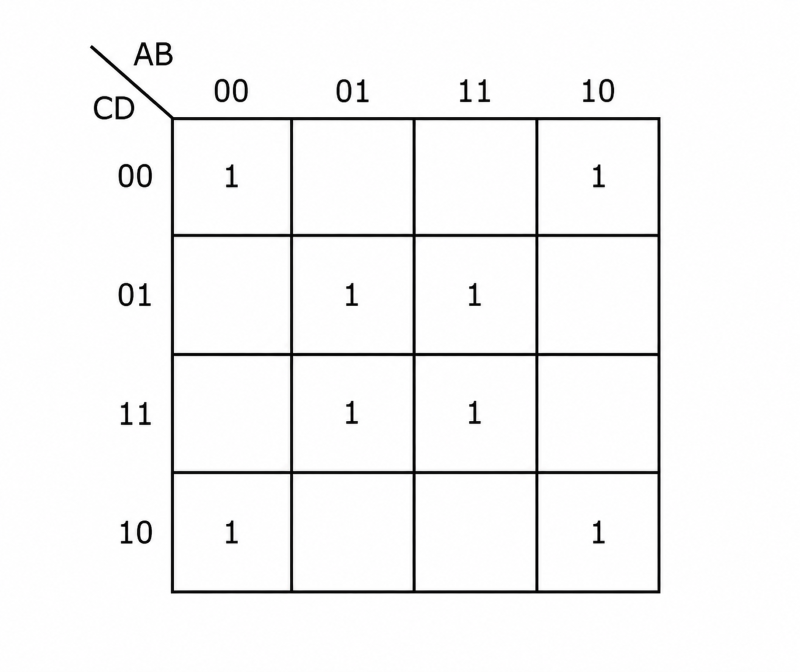
Question 64.
The following is an 8085 assembly language program:
MVI B, OAH
MVI A, 05H
LXI H, IC40H
CALL SUB
HLT
SUB CMP M
RZ
INX H
DCR B
JNZ SUB
RET
(a) What does the program do?
(b) What are the contents of registers A and B initially?
(c) What are the contents of HL register pair after the execution of the program?
Question 65.
(a) An asynchronous serial communication controller that uses a start stop scheme for controlling the serial I/O of a system is programmed for a string of length seven bits, one parity bit (odd parity) and one step bit. The transmission rate is 1200 bits/second.
(i) What is the complete bit stream that is transmitted for the string ‘0110101’?
(ii) How many such strings can be transmitted per second?
(b) Consider a CRT display that has a text mode display format of 80 × 25 characters with a 9 × 12 character cell. What is the size of the video buffer RAM for the display to be used in monochrome (1 bit per pixel) graphics mode?
Question 66.
The following is an incomplete Pascal function to convert a given decimal integer (in the range -8 to +7) into a binary integer in 2’s complement representation. Determine the expressions A, B, C that complete the program.
function TWOSCOMP (N:integer):integer;
var
RAM, EXPONENT:integer;
BINARY :integer;
begin
if(N>=-8) and (N<=+7) then
begin
if N<0 then
N : = A;
Binary:=0;
EXPONENT:=1;
While N<>0 do
begin
REM:=N mod 2;
BINARY:=BINARY + B*EXPONENT;
EXPONENT:=EXPONENT*10;
N :=C
end
TWOSCOMP:=BINARY
end
end;
Question 67.
Consider the following program segment for concurrent processing using semaphore operators P and V for synchronization. Draw the precedence graph for the statements S1 to S9.
var
a, b, c, d, e, f, g, h, i, j, k : semaphore;
begin
cobegin
begin S1; V(a); V(b) end;
begin P(a); S2; V(c); V(d) end;
begin P(c); S4; V(c) end;
begin P(d); S5; V(f) end;
begin P(e); P(f); S7; V(k) end;
begin P(b); S3;V(g);V(h) end;
begin P(g); S6; V(i) end;
begin P(h); P(i); S8; V(j) end;
begin P(j); P(j); P(k); S9 end;
coend
end;
Question 68.
The head of a moving head disk with 100 tracks numbered 0 to 99 is currently serving a request at track 55. If the queue of requests kept in FIFO order is
10, 70, 75, 23, 65
Which of the two disk scheduling algorithms FCFS (First Come First Served) and SSTF (Shortest Seek Time First) will require less head movement? Find the head movement for each of the algorithms.
Question 69.
Let G1 and G2 be subgroups of a group G.
(a) Show that G1∩G2 is also a group of G
(b) Is G1∪ G2 always a subgroup of G?
Question 70.
How many minimum spanning trees does the following graph have? Draw them. (Weights are assigned to the edge).
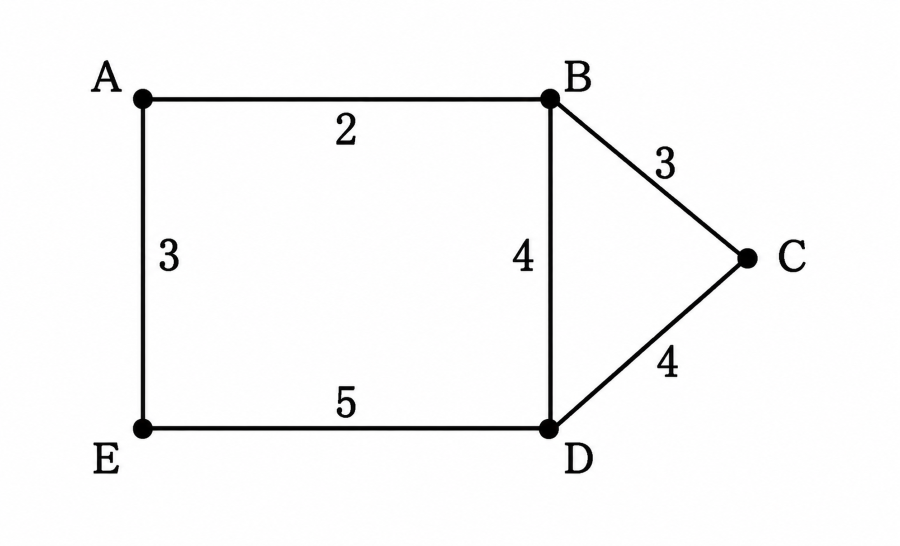
Question 71.
Prove using mathematical induction for n ≥ 5,
2n > n2
Question 72.
Prove that in finite graph, the number of vertices of odd degree is always even.
Question 73.
(a) Find the minimum value of 3 – 4x + 2x2.
(b) Determine the number of positive integers (≤720) which are not divisibly by any of numbers 2, 3, and 5.
Question 74.
(a) Consider the relation scheme R(A, B, C) with the following functional dependencies:
A, B → C,
C → A
Show that the scheme R is the Third Normal Form (3NF) but not in Boyce Code Normal Form (BCNF).
(b) Determine the minimal keys of relation R.
Question 75.
Consider the relation scheme.
AUTHOR (ANAME, INSTITUTION, ACITY, AGE)
PUBLISHER (PNAME, PCITY)
BOOK (TITLE, ANAME, PNAME)
Express the following queries using (one or more of) SELECT, PROJECT, JOIN and DIVIDE operations.
(a) Get the names of all publishers.
(b) Get values of all attributes of all authors who have published a book for the publisher with PNAME = ‘TECHNICAL PUBLISHERS’.
(c) Get the names of all authors who have published a book for any publisher located in Madras.